

Companies replacing workers with AI are no longer just a prediction about the future.
It is already happening.
Artificial intelligence is changing how companies manage customer support, administration, software development, marketing and many other business tasks.
However, the situation is more complex than simply saying, “AI is taking everyone’s jobs.”
Some companies have reduced staff directly after introducing AI. Others have stopped replacing employees who leave. Some are reducing contractors, while others are redesigning existing jobs around AI.
Here are five major examples that show how the AI workforce is already changing businesses around the world.
1. Salesforce Reduced Customer Support Roles After Introducing AI Agents
Salesforce provides one of the clearest examples of companies replacing workers with AI.
Salesforce CEO Marc Benioff revealed that the company had reduced its customer support workforce from around 9,000 people to approximately 5,000.
AI agents now handle a significant amount of customer interaction.
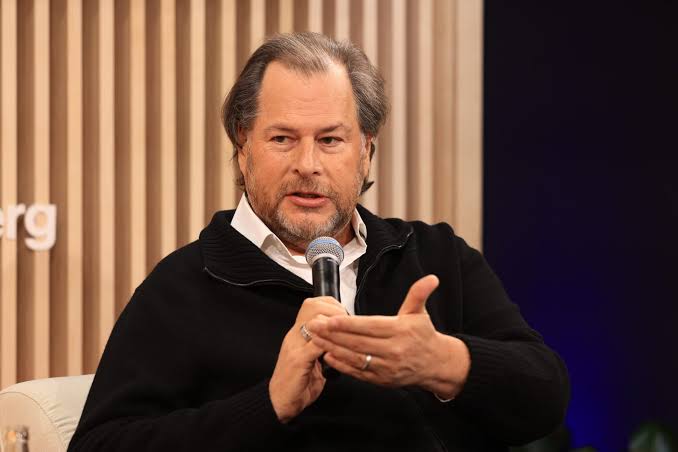
According to Benioff, around half of Salesforce’s customer conversations can now involve AI agents while human employees handle the remaining interactions.
This represents an important change in customer service.
Previously, companies needed large support teams to answer repetitive questions, update information and manage customer requests.
Today, an AI chatbot or AI agent can handle many of these tasks automatically.
Human employees can then focus on more complicated customer problems.
For businesses, this does not necessarily mean removing the entire customer service department.
Instead, it can mean operating a larger customer service operation with fewer people.
2. Klarna Used AI to Handle Work Equivalent to Hundreds of Employees
Swedish fintech company Klarna became another widely discussed example of AI automation in the workplace.
The company reduced its workforce from around 5,000 employees to approximately 3,800.
However, there is an important detail.
Most of the reduction happened through attrition. In other words, Klarna often chose not to replace employees who left the company instead of conducting a direct mass layoff.
At the same time, its AI assistant was reportedly performing work equivalent to around 700 full-time customer service employees.
The company also reported major improvements in customer support efficiency.
Average issue resolution time fell from about 11 minutes to around two minutes.
This demonstrates another way companies replacing workers with AI may operate.
Instead of firing employees immediately, a business may simply stop hiring additional people.

For example:
A company has 20 customer service employees.
Three employees resign.
Instead of hiring three replacements, the company introduces AI automation.
The business continues operating with 17 employees supported by AI.
Over time, the company becomes smaller while maintaining similar or even higher productivity.
Businesses can apply the same concept to lead automation, customer enquiries and other repetitive processes.
3. Duolingo Adopted an “AI-First” Strategy
Duolingo has taken a different approach.
The language learning company announced an AI-first strategy and began using artificial intelligence for work previously performed by some contractors.
One major example is content production.
Duolingo used generative AI to help launch 148 new language courses in less than one year.
According to Reuters, creating the company’s first 100 courses took around 12 years.
AI dramatically changed that production process.
This does not mean every Duolingo employee has been replaced.
Instead, the company is changing how work gets completed.
Tasks that previously required large amounts of manual content production can now be accelerated with AI.
This model will likely become increasingly common.
Companies may maintain smaller teams while using AI to increase their output.
A marketing team provides a simple example.
Previously, a business might need several employees to:
- prepare marketing emails,
- analyse leads,
- create initial content drafts,
- organise customer data,
- prepare reports, and
- schedule campaigns.
With marketing automation, some of these repetitive tasks can run automatically.
Employees can then focus on strategy, creativity and decision-making.
4. Standard Chartered Announced Thousands of Back-Office Job Cuts
The impact of AI is not limited to technology companies.
The banking industry is also changing.
In 2026, Standard Chartered announced plans to cut nearly 8,000 jobs as the bank increased its adoption of AI and technology.
The changes affected a significant portion of its back-office support workforce.
CEO Bill Winters described the shift as moving investment away from some lower-value human tasks and towards technology.
The comments generated criticism and concern among employees.
However, they also highlight an important trend.
AI automation is increasingly moving beyond simple chatbots.
Businesses can now use AI for tasks such as:
- document processing,
- data analysis,
- internal support,
- reporting,
- compliance assistance,
- customer enquiries, and
- workflow automation.
Therefore, administrative and repetitive back-office work may face greater automation pressure.
However, businesses still need human oversight.
Financial decisions, complex customer cases and sensitive operations still require human judgement.
The future is more likely to involve AI supported employees rather than completely autonomous companies.
5. TCS Shows How AI Is Changing the Traditional IT Workforce
Artificial intelligence is also changing the IT outsourcing industry.
Tata Consultancy Services, better known as TCS, announced cuts affecting more than 12,000 positions during its workforce restructuring.
However, it is important to understand the difference here.
TCS did not describe the layoffs simply as “AI replacing employees.”
The company’s leadership pointed to skills mismatch and workforce restructuring.
At the same time, AI is changing how the wider IT services industry operates.
AI coding agents can now perform parts of basic software development, testing, documentation and technical support.
As a result, companies may no longer require the same large number of entry-level employees for certain tasks.
The traditional business model was simple:
More projects = more employees.
AI changes that equation.
The new model may become:
More projects = smaller skilled team + AI tools + automation.
Therefore, companies do not necessarily need to replace every worker directly with AI.
They may simply need fewer new employees as productivity increases.
Are Companies Really Replacing Employees With AI?
Yes, but not always in the way people imagine.
There are several different scenarios.
Direct job replacement
AI performs a task previously handled by an employee, so the company reduces the number of people required.
Salesforce customer support provides a strong example.
Employees leave and are not replaced
Instead of retrenching workers, the company allows its workforce to decrease naturally.
AI then absorbs part of the workload.
Klarna followed this approach extensively.
Contractors are reduced
Companies may use AI instead of outsourcing certain repetitive tasks to freelancers or contractors.
Duolingo has applied AI to work that previously involved contract workers.
Companies hire fewer junior employees
AI can automate basic tasks.
Therefore, businesses may not need as many entry-level employees as before.
This trend is particularly important in software development, customer service and administrative work.

Existing employees become more productive
This may ultimately become the most common model.
For example, one employee supported by several AI tools may eventually produce the same output that previously required two or three employees.
Which Jobs Are Most Exposed to AI Automation?
AI is currently strongest when work is repetitive, digital and based on predictable processes.
Therefore, roles involving the following tasks may experience faster changes:
- customer support,
- data entry,
- basic administration,
- appointment management,
- simple content drafting,
- lead qualification,
- email follow-ups,
- basic reporting,
- document processing, and
- repetitive coding tasks.
However, AI still struggles with many situations that require deep judgement, human relationships, physical work, leadership or complex decision-making.
The question businesses should ask is not:
“How many employees can AI replace?”
A better question is:
“Which repetitive tasks can AI handle so our employees can focus on higher-value work?”
That creates a more sustainable AI strategy.
AI Workforce: The Bigger Business Opportunity
The biggest change may not be mass layoffs.
Instead, companies could simply become more efficient.
Imagine a company that previously needed:
10 employees + manual processes.
After introducing AI, it may operate with:
6 employees + AI agents + automation.
The company can then serve more customers without increasing headcount at the same rate.
For small and medium businesses, this can be particularly valuable.
A small company may not be able to hire separate employees for customer support, marketing, lead management and administrative work.
An AI workforce can help automate parts of these functions.
For example, AI can answer common customer questions.
It can also capture leads from a website, classify enquiries and trigger follow-up actions.
Businesses can combine this with email automation to continue communicating with prospects automatically.
The goal is not necessarily to remove humans.
The goal is to give a smaller team more capability.
Will AI Eventually Replace Most Employees?
Probably not.
At least, not in the near future.
Even as AI adoption increases, companies still need people who can:
- make strategic decisions,
- manage customer relationships,
- solve unusual problems,
- supervise AI outputs,
- understand business context,
- create new ideas, and
- take responsibility for important decisions.
The workforce itself will change.
Employees who understand how to work with AI may also become significantly more productive than employees who rely entirely on traditional processes.
Therefore, businesses should think about human + AI collaboration rather than AI versus humans.
What Does This Mean for Businesses in Malaysia?
Malaysian businesses do not need to copy large technology companies immediately.
A better approach is to start with repetitive processes.
For example, identify tasks that employees repeat every day.
These may include:
- answering the same customer questions,
- collecting customer information,
- qualifying leads,
- sending follow-up emails,
- updating records,
- preparing simple reports, and
- forwarding enquiries to the correct department.
These tasks are good candidates for AI automation.
Businesses can then measure the results.
Does AI reduce response time?
Does the company handle more leads?
Does the team spend less time on repetitive work?
Does customer service improve?
If the answer is yes, the business can gradually expand its automation.
Explore Airatech’s AI automation services to see how AI can support different business processes.
AI Will Change Headcount, But Productivity Is the Bigger Story
The rise of companies replacing workers with AI shows that artificial intelligence is beginning to affect real workforce decisions.
Salesforce has reduced customer support roles.
Klarna has allowed its workforce to shrink while AI handles more customer enquiries.
Duolingo is using an AI-first operating model.
Standard Chartered is restructuring back-office operations.
Meanwhile, TCS shows how AI is changing traditional hiring and outsourcing models.
Still, the biggest business opportunity is not simply cutting jobs.
It is increasing productivity.
A company that combines skilled employees with AI agents may serve more customers, respond faster and operate more efficiently without continuously expanding its workforce.
That may become one of the defining business advantages of the AI era.
Ready to Introduce AI Into Your Business?
You do not need to replace your entire team to benefit from artificial intelligence.
Start with one repetitive process.
Automate it.
Measure the improvement.
Then expand from there.
Airatech helps businesses implement AI chatbots, lead automation, marketing automation and AI-powered workflows designed around real business processes.
Book an AI automation demo and discover which parts of your business can be automated.
Frequently Asked Questions About AI Replacing Jobs
Are companies really replacing workers with AI?
Yes. Some companies have already reduced certain roles after introducing AI. However, other companies are using attrition, reduced hiring or fewer contractors rather than direct layoffs.
Which company has replaced employees with AI?
Salesforce is one of the clearest examples. CEO Marc Benioff said the company reduced its customer support workforce significantly as AI agents began handling more customer conversations.
What jobs can AI replace?
AI is most effective at repetitive and predictable digital tasks. These include basic customer support, data entry, lead qualification, administrative work, simple reporting and certain entry-level coding tasks.
Will AI replace all workers?
That is unlikely in the near future. Many jobs require human judgement, creativity, relationships, responsibility and complex decision-making.
How can small businesses use AI?
Small businesses can start with AI chatbots, automated lead management, email automation, reporting and repetitive administrative workflows.
Is AI automation suitable for Malaysian businesses?
Yes. Malaysian businesses can use AI automation to improve response times, reduce repetitive work and increase productivity without immediately increasing their workforce.